practical guide
How do I run a tester round for a new sewing pattern without losing three months?
A tester round has a fixed shape: application, cohort selection, a dated call file, staged feedback windows and a correction log. Here is how each stage fits into a working release calendar.
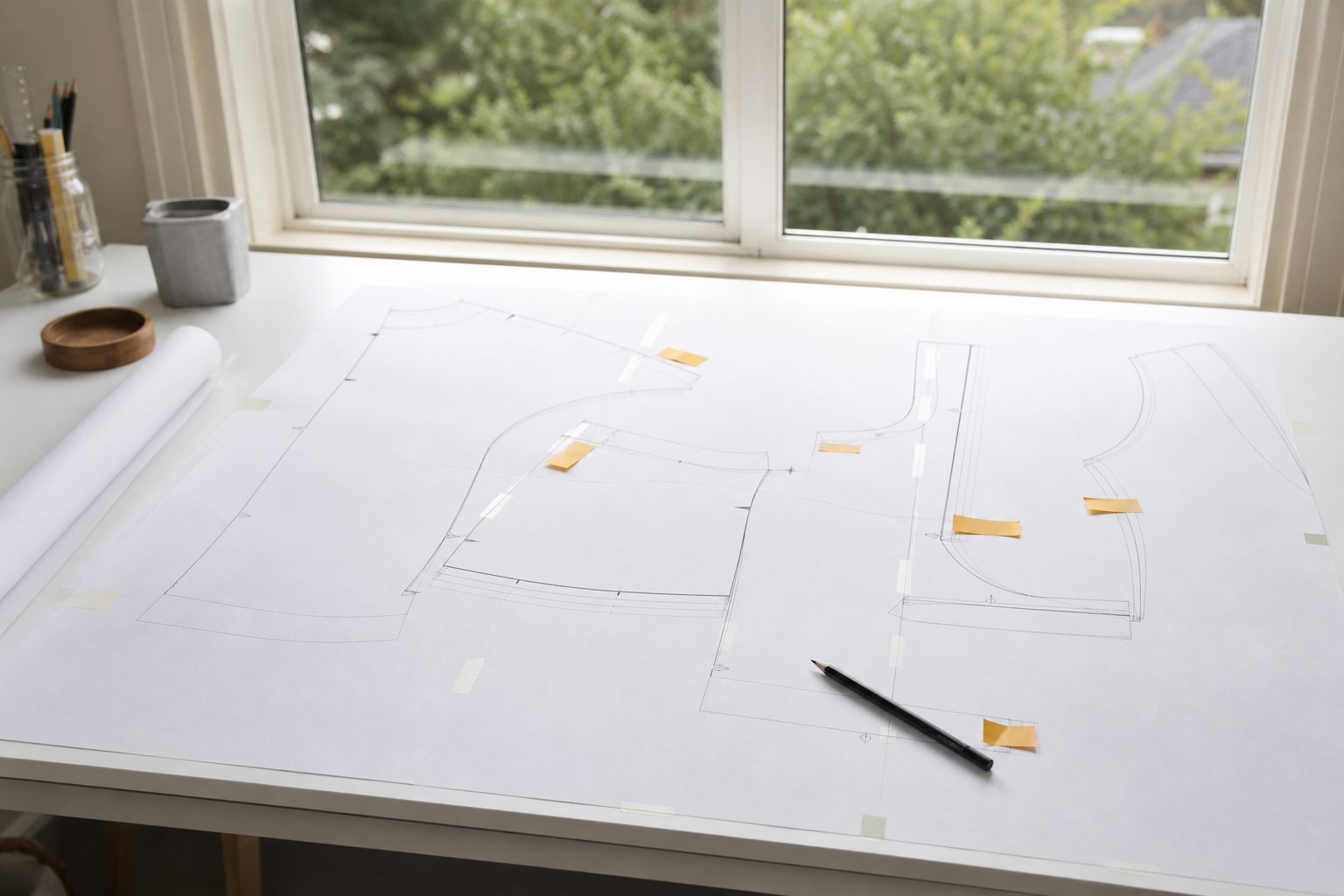
A tester round takes about five weeks from the day you send the call file to the day you have a corrected pattern ready to sell. It stretches to three months when the call has no dates in it, when testers are recruited one at a time as they volunteer, and when feedback arrives as a scroll of chat messages that you have to reread every time you make an edit.
The fix is structural, not motivational. Set the sew-by dates before you recruit. Recruit the whole cohort in one window and close it. Ask for feedback in two staged batches instead of one final dump. And keep a correction log that names a page and a line for every change, so that when you finish you know exactly what changed and can tell buyers.
Here is the shape of a round that finishes on time, stage by stage.
What a tester round is actually testing, and what it is not
A tester round tests whether a stranger can follow your instructions to a finished garment using only what you gave them. That is the whole job. It is a comprehension and accuracy check on a document.
It is specifically testing four things: that the pattern pieces print at the correct scale and assemble into a complete piece, that the seam lengths and notches actually match, that the written steps happen in a workable order with nothing assumed, and that the finished measurements land where your size chart promises.
It is not testing whether people like the design. That question belongs earlier, before you graded anything. It is not a substitute for your own fit work on a form or a fit model, and it is not free labor to produce photos, although photos are a normal byproduct you should ask permission for.
Keep reading: Should I sell my knitting patterns on Ravelry, on my own site, or on both at once?
Recruiting a size range that covers your grade, not just your friends
The most common recruiting failure is a cohort clustered in the middle of your range. If you graded from a size 8 block out to a 30 and every tester lands between 10 and 18, you have tested the part of the grade least likely to break.
Decide your coverage target before you open applications. A workable rule for a range of, say, twelve sizes: cover both end sizes, cover every third size in between, and get two testers at each of the top two sizes because that is where dart intake and armscye depth are most likely to fail.
For a 6 to 28 range in even sizes, that is roughly:
- Size 6: one tester
- Sizes 12, 18, 22: one tester each
- Sizes 26 and 28: two testers each
Eight to ten people. Expect a drop rate. Somewhere between a fifth and a third of testers do not finish, for entirely ordinary reasons: a sick kid, a broken machine, a job. Plan for it by recruiting one or two extra in the sizes you most need rather than by chasing people mid round.
Writing the tester call: dates, deliverables and what you provide
The call file is the contract. Vague calls produce vague rounds. Every date should be a real calendar date, not a duration.
A complete call names: the garment and its fabric requirements, the size range and finished measurements, the application close date, the notification date, the date files go out, the first check-in date, the final feedback date, the compensation, and what you need in return.
State what you provide and what you do not. You provide the PDF in every format you sell, the size chart, a fabric spec, and answers within a stated turnaround. You do not provide fabric, notions, or postage unless you say you do. Testers buy their own materials in most independent rounds, and they should know that before applying.
Paid, discounted or free: three common compensation structures
There is no industry standard here, and anyone claiming one is guessing. What exists is three recognizable structures, each with a different obligation attached.
| Structure | What the tester gets | What you can reasonably ask |
|---|---|---|
| Free copy | The finished pattern at release, no cash | Completed garment, written feedback, measurements. Photos optional. |
| Free copy plus store credit | Pattern plus credit toward future releases | The above plus at least one usable photo, plus a follow-up on a revised file |
| Flat fee | A cash payment, often on completion | The above plus a defined turnaround and photos to a stated spec |
Run the arithmetic before you promise cash. Ten testers at $40 each is $400. If your pattern sells for $12 and you net roughly $10 after processing and platform costs, you need forty sales to recover the testing spend alone, before the design time. That may be perfectly sensible for a pattern you expect to sell for years. It is a bad idea for a small seasonal accessory.
Whatever you choose, put it in the call in dollars, and pay when you said you would.
Keep reading: What are the most common grading errors that only show up in the largest sizes?
Feedback windows and why staggered deadlines beat one hard date
One deadline gives you one enormous pile of contradictory notes on the last day, at which point every correction is expensive because the whole cohort has already sewn the whole garment.
Stagger it instead. Two checkpoints work for most garments:
- Checkpoint one, printing and cutting. Due four days after files go out. Testers print, tape, check the test square, cut, and report only on the pieces: scale, layout page order, piece count, notch presence, grainlines. Nothing is sewn yet.
- Checkpoint two, construction and fit. Due at the end of the sew window. Full step-by-step notes plus finished garment measurements against your chart.
The first checkpoint catches the class of error that would otherwise waste everyone's fabric: a piece exported at the wrong scale, a missing facing, a layout where page 14 duplicates page 13. Fixing that on day four and reissuing a corrected file costs you an evening. Finding it on day twenty-one costs you the round.
A workable calendar, from the top:
- Days 1 to 7: applications open
- Day 8: cohort selected and notified, non-selected applicants told
- Day 10: files sent
- Day 14: checkpoint one due, corrections issued by day 16 if needed
- Days 16 to 31: sew window
- Day 31: checkpoint two due
- Days 32 to 38: corrections, version bump, final proof
Five and a half weeks. The slack is deliberate and it lives at the end, where late feedback actually arrives.
Logging corrections so each one maps to a page and a line
Feedback that lives in a group chat is not a record. You will make an edit, forget which report it came from, and have no way to tell a buyer what changed.
Log every reported item as a row with these fields: reporter, size sewn, page number, step or piece reference, what they observed, your classification, and the resolution.
Classify each row into one of four buckets:
- Error. The pattern is wrong. Seam lengths differ, a measurement is mistyped, a step is out of order. Always fix.
- Ambiguity. The pattern is technically right but two testers read it differently. Usually fix, by rewording or adding a diagram.
- Preference. A design opinion. Record and set aside.
- Tester error. They skipped a step or used the wrong seam allowance. Do not change the pattern, but note it, because two tester errors in the same step is an ambiguity wearing a disguise.
The classification column is the one that saves you. It stops the round from turning into a redesign, and it gives you the exact list of what belongs in an errata note.
See how StitchPattern handles this for independent sewing and knitting pattern design
Deciding when a change means a new version number
Use a two-part number: major.minor, as in 2.1. The rule that holds up in practice is about whether a buyer holding the old file needs to act.
- Minor bump for anything that does not change a printed piece or a measurement: a clearer sentence, a corrected typo in prose, a better diagram, a fixed link.
- Major bump for anything that changes a pattern piece, a cutting quantity, a finished measurement, a yardage requirement, or a construction step's order or outcome.
Put the version and a date on the first page and in the filename. Keep a short changelog page inside the PDF listing each version, the date, and one line per change. When a buyer emails asking whether they have the current file, that page answers it in ten seconds.
Anything that earns a major bump also earns a notification to everyone who already bought the pattern. That is not a courtesy, it is the difference between an errata process and a rumor.
Closing the round: photos, credit and permission to use them
Close the round explicitly, on a date, with a message. Tell testers which of their reports changed the pattern, by name where you can. People who see their note in the changelog apply again.
Collect photo permission in writing, separately from the feedback form, and be specific: which images, which uses, whether their name or handle appears, and whether the permission extends to paid ads or only to your own site and social posts. Store the permissions with the images, not in your inbox.
Send the final file to the whole cohort, including the people who dropped out, and thank them anyway. Then archive the correction log with the pattern files. Two years from now, when someone reports something odd about the sleeve, that log tells you whether it is new.
Where this leaves you
The timeline is not the hard part. The hard part is that a round produces three separate streams of work at once: a cohort to manage, a correction log to maintain, and a version history to publish to people who already paid you. Handling those in a chat thread, a spreadsheet and your memory is what turns five weeks into three months.
StitchPattern is built for exactly that shape of work: run the tester round with dated stages, log every correction against a page and a line, tie the resolved corrections to a version number, and push the errata to every previous buyer when the version changes. One place, one record, one file that everyone who bought it is holding.