field report
What does a tech editor actually do to a knitting pattern before it goes out the door?
Tech editing is arithmetic and consistency work: stitch counts, row math, gauge to schematic agreement, chart and written line matching, and abbreviation discipline across every size.
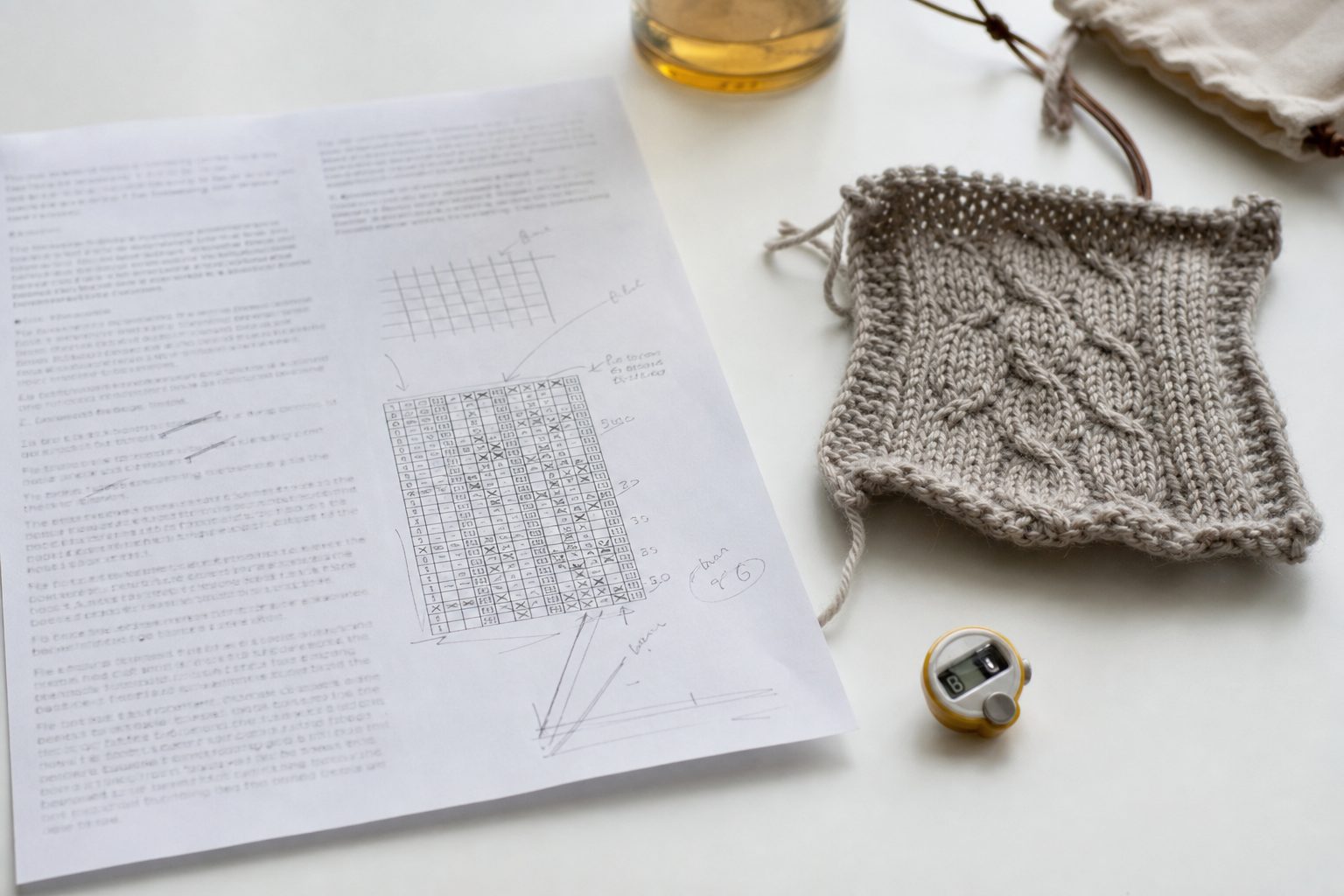
A tech editor checks the arithmetic and the consistency of your pattern, size by size, line by line. They recalculate stitch and row counts through every increase, decrease and bind off; they confirm the gauge you stated produces the measurements on your schematic; they read charts against written instructions to be sure both say the same thing; and they enforce one vocabulary and one style across the whole document.
What they are not doing is knitting the sweater. They work on paper, from your numbers, and their job is to find the places where the numbers disagree with each other. That is a narrower job than most first time designers expect, and understanding the boundary is what makes the edit worth the fee.
Below is what actually happens between the moment you send the file and the moment it comes back marked up.
What arrives on a tech editor's desk and in what format
Most editors ask for a Word document or a Google Doc, not a laid out PDF, because they need to leave tracked changes and comments in the text itself. Send the design file too late in the process and you pay twice: once for the edit, and again for redoing the layout around the corrections.
Alongside the manuscript, an editor will normally want your schematic with measurements, your gauge swatch numbers, your grading spreadsheet if you have one, and a note on your target ease. The spreadsheet matters more than designers expect. If the editor can see how you derived a number, they can tell you where the derivation broke instead of just flagging that the result looks wrong.
They will also ask what kind of edit you want. A full edit covers math, consistency, style and readability. A math only pass is cheaper and covers exactly what its name says. Decide before you send, because scope creep discovered mid edit turns an hourly quote into a surprise.
Keep reading: How do I run a tester round for a new sewing pattern without losing three months?
Stitch and row math checked size by size
This is the bulk of the work and the reason the fee scales with the size count. The editor rebuilds your numbers independently. They start with the cast on for each size and carry the count forward through every shaping instruction, checking that the arithmetic lands where the pattern says it lands.
A raglan yoke is the classic example. If size 4 casts on 88 stitches at the neck, works increases every other round eight times at four increase points, the count after the yoke should be 88 plus 64, which is 152. If the pattern then says to divide for sleeves and body using numbers that total 148, something is wrong and the editor's job is to say which of the two numbers is the error.
Row math gets the same treatment. Sleeve decreases worked every sixth round twelve times consume 72 rounds. If the sleeve length from underarm to cuff at your row gauge is only 64 rounds, the shaping does not fit and either the interval, the repeat count or the stated length has to move.
Gauge, schematic measurements and finished dimensions agreeing
The editor takes your gauge, divides the stitch count at a given point by the stitches per inch, and compares the result against the schematic. Every labeled dimension gets this treatment: chest, upper arm, cuff, neck opening, body length, yoke depth.
At 22 stitches over 4 inches, that is 5.5 stitches per inch. A body of 220 stitches in the round measures 40 inches. If the schematic says 40 and the size chart promises 4 inches of positive ease over a 36 inch bust, everything agrees. If the schematic says 41, one of three things is wrong and the editor will tell you which is most likely.
They will also check that the grade is smooth. Finished chest measurements that go 34, 38, 42, 45, 50 have a jump the designer probably did not intend, and an editor who sees it will flag the irregular step even though every individual number is internally correct.
Charts versus written instructions saying the same thing
If you publish both, they have to match cell for cell. The editor reads the chart symbol by symbol against the written line and confirms three things: the same operations in the same order, the same total stitch count per row, and the same repeat boundaries.
Chart problems cluster in predictable places. Reading direction on wrong side rows, where a right leaning decrease charted from the right side becomes a different written instruction on the wrong side. Repeat boxes whose edges do not sit where the written "repeat from star to star" implies. Symbol keys that list a symbol the chart never uses, or use a symbol the key never defines.
The editor also checks that the chart is legible at print size and that no row is ambiguous about whether it is worked flat or in the round. Those are readability notes rather than math, but they arrive in the same markup.
Keep reading: Should I sell my knitting patterns on Ravelry, on my own site, or on both at once?
Abbreviations, style sheets and house consistency
Every abbreviation used must appear in the key, and every abbreviation in the key must appear in the pattern. Editors run this both directions and it catches leftovers from the pattern you copied your template from.
Consistency work also covers the small decisions you make unconsciously and then break: whether you write "k2tog" or "K2tog," whether numbers under ten are spelled out, whether sizes are given as 1 through 8 or as finished chest measurements, whether stitch counts appear in parentheses at the end of every shaping row or only sometimes. Pick one, and the editor will enforce it.
If you publish more than one pattern a year, write a style sheet. One page, listing your capitalization rules, your size naming, your standard section order, your preferred phrasing for common instructions. Send it with the manuscript. It cuts the consistency portion of the edit substantially, because the editor is checking against your stated rules instead of inferring them and asking.
What belongs on a style sheet
- Abbreviation capitalization and the full list you use.
- How sizes are named and in what order they are always listed.
- Whether stitch counts follow every shaping row or only section ends.
- Standard wording for "at the same time" instructions and for size specific brackets.
- Your section order: materials, gauge, notes, construction, finishing, schematic.
Yarn quantity estimates and substitution notes
An editor will sanity check your yardage against the finished garment. The usual method is a rough area or weight comparison: a sample in size 4 that used 1,150 yards, graded up through sizes that each add roughly 8 to 10 percent in area, should show yardage that climbs at a similar rate. Yardage that goes 1,150, 1,250, 1,300, 1,700 has an error in it.
They will also push you to state the sample details completely: the yarn, the exact colorway, the size knitted, and the yardage that size actually consumed with a note on how much was left. That last detail is the one that keeps buyers from running short by half a skein.
On substitutions, the editor checks that you have described the yarn's characteristics rather than only naming it. Fiber content, ply structure, whether the fabric relies on drape or on memory. A buyer substituting a superwash merino for a woolen spun rustic wool needs to be told the fabric will behave differently, and that note is part of the pattern, not part of the marketing.
See how StitchPattern handles this for independent sewing and knitting pattern design
What a tech editor does not do, and why testers are still needed
The editor does not knit your pattern. They cannot tell you that the instruction for joining the sleeve is technically correct but impossible to follow at eleven at night, or that everyone finds the neckline too tight regardless of what the schematic says, or that a step reads clearly to an experienced knitter and stops a confident beginner cold.
They also do not test your design decisions. If you specified two inches of negative ease and the math is consistent with two inches of negative ease, the edit passes. Whether the garment looks right at that ease is your call and your testers' evidence.
| Question | Tech editor | Test knitters |
|---|---|---|
| Do the stitch counts work? | Yes | Sometimes, by accident |
| Does the schematic match the gauge? | Yes | No |
| Is step 14 confusing? | Maybe | Yes |
| Does it fit a real body? | No | Yes |
| Is the yardage enough in practice? | Estimates | Confirms |
| Is the finishing achievable? | No | Yes |
Run both. The order matters: edit first, then test, so your testers spend their goodwill on the design rather than on your arithmetic.
How to hand off a pattern so the edit costs less
Everything that reduces the editor's guessing reduces your bill. Send a clean manuscript in one document, one size set, one abbreviation key, with the schematic fully labeled and your grading numbers attached. Number your sections. Do not send a file you are still editing.
Answer the editor's questions in one batch rather than in a trickle across a week, because every context switch is billable time on an hourly quote.
And keep the corrections organized when they come back. A tech edit generates dozens of small changes, each of which must land in the layout file, and it is entirely normal to fix nine of ten and lose track of the tenth until a buyer finds it.
Where this fits in your release
The edit is one stage in a chain: draft, grade, edit, test, correct, release, and then correct again when something surfaces in the wild. The chain breaks where the record of what changed lives in your inbox.
StitchPattern keeps that record in one place. Run the tester round with every comment attached to a section and a size, log the corrections against a version number as you make them, and when a fix arrives after launch, push the updated file to everyone who already bought it rather than hoping they notice a post. The editor's markup and the testers' reports stop being loose paper and become the release history of the pattern.